
Wouldn’t it be nice to be a reptile?
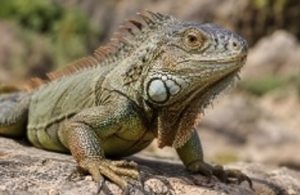
No moral dilemmas.
No overthinking.
No worrying about yesterday or tomorrow.
Just respond to the environment and get on with life.
The term “reptilian brain” refers to our more primitive brain systems involved in basic survival functions. While it isn’t an anatomical location in our brain, it is a simple way of thinking about some of our more automatic survival responses.
The word autonomic means “self-governing.”
You already know that the autonomic nervous system (ANS) regulates many of our body’s functions largely without our conscious control. But here’s where it gets interesting for us physiotherapists.
In this report, I want to share with you the role of the ANS in how we respond to pain. The ANS doesn’t actually create pain by itself. But when the brain perceives threat, it can activate the stress response, leading to changes in heart rate, breathing, muscle tension, gut activity, etc.
When a reptile experiences something potentially threatening or painful, it also has similar biological stress responses that help it survive. Reptiles also respond to painful stimuli, by demonstrating similar pain-related behaviours (Perry et al 2018).
So, what’s different about us?
Well… we’re human. When we experience pain, we don’t just respond to what is happening right now. We also bring along our memories. Our previous experiences. Our beliefs. Our emotions.
And perhaps most importantly, our predictions about what might happen in the future.
Imagine a patient who is afraid of bending forward because, in the past, lumbar flexion has repeatedly produced their low back pain.
They bend → They fear → They hurt
The brain receives a message: “There it is. I was right to predict danger.”
The prediction gets reinforced. Over time, the association can become automatic:
Movement X → Danger → Pain
But here’s the good news. This pattern is potentially reversible.
If the same patient repeatedly bends forward, but this time with less range, less fear or possibly in a different way… their prediction may change as long as nothing bad happens.
Perhaps there is some discomfort, but there is no injury, no catastrophe… and the patient remains calm.
Now the brain receives a different message:
“Hmm… that wasn’t what I predicted.”
That’s a prediction error. Repeated prediction errors can gradually update the brain’s prediction model.
Movement X → No danger
And when the brain begins to predict less danger, the need for pain as a protective response may decrease.
This is one of the principles behind Graded Exposure Therapy (G.E.T.).
Physiotherapy treatments should not simply be about forcing patients to perform the movements they fear. They should be about giving our patients’ nervous systems new experiences from which they can learn:
“Maybe this movement isn’t as dangerous as I thought.”
And this is where I think the reptile analogy becomes interesting. A reptile doesn’t sit at home that night thinking: “Oh my God… that was terrifying. I wonder if I’ll ever be able to bend again.” (At least, I assume it doesn’t.)
Reptiles respond to an immediate threat and then get on with being a reptile.
We humans aren’t quite so lucky.
We can experience something painful… remember it… fear it happening again… predict that it will happen again… and then start protecting ourselves from something that isn’t even happening anymore.
A painful movement on Monday can become a feared movement on Friday.
The original threat may be gone. But the prediction remains. And that prediction can influence how we move, how we think, how we feel and potentially how much pain we experience.
“THE THREAT MAY BE GONE.
THE PREDICTION MAY REMAIN.”
As the years go by, I am learning that most often, I don’t even need to treat the painful body part… I just need to change my patient’s predictions of danger.
To learn more about G.E.T., watch my video on the topic or come to one of my courses, where this concept is at the heart of what I teach.
Perhaps life would be so much simpler if I was a reptile. No worrying about yesterday. No worrying about tomorrow. Just:
Threat → Respond → Survive.
But then again… I wouldn’t want to be a reptile.
We have the capacity to suffer deeply… because we also have the capacity to love deeply.
And personally… I’ll take that trade-off.